The attached article is interesting - shows how we are beginning to ask our communities to take a greater role in funding conservation works in our National Parks.
http://news.bbc.co.uk/1/hi/england/north_yorkshire/8042863.stm
It will be interesting to see how they fare at a time when household budgets are being squeezed. Although, with a bumper year for UK tourism predicted, a carefully targeted scheme could tap into not just community interest, but also the pockets of the many people who visit the Parks each year.
Whether or not the funds raised will make a real difference remains to be seen. But then again, every little helps!
Sunday, 10 May 2009


Thursday, 23 April 2009
An early morning walk through the cemetery!
 The dogs are obviously operating on Berlin time as they are waking up at around 5 am these days. This morning I couldn't get back to sleep after letting them out for their first comfort break of the day, so got up and decided to take the early train to work. Walking through the Victorian cemetery that lies between home and the station at 6 am, I could barely hear myself think because of the cacaphony coming from the trees and bushes - this really was a dawn chorus to remember. It reminded me of the incredible wildlife value of some of our historic graveyards - an aspect that is often forgotten by those of us who live busy lives, rushing from place to place and rarely taking the time to stop, look, listen and celebrate the ordinary.
 Fortunately, there are some community groups who are beginning to take an interest in managing historic graveyards for both their cultural and natural heritage interest. In York there is a long established group who run education programmes for local schools using the city's graveyards as a resource to teach lessons on, for instance, biology or local history (the Victorians - a classic topic at Key Stage 2 in English schools). And in Bradford, moves are afoot to encourage much more public engagement with the city's fine Undercliffe Cemetery.
So next time you are passing a graveyard, pop in and see what you can learn!
Monday, 13 April 2009
Heritage and Contemporary Culture in Jordan
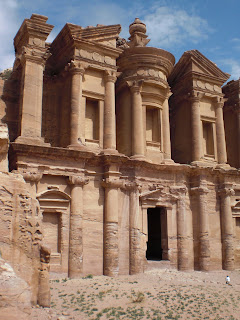 Jordan’s rich heritage includes sites associated with, amongst other cultures, the Nabateans, Romans, Ummayids, Byzantines and Ottomans, as well as some of the most important locations associated with the region’s three monotheistic religions – Christianity, Judaism and Islam.
Seeing how these sites are being packaged, presented and managed for Jordan’s growing tourism sector has been particularly instructive in terms of reminding me of the plurality of interests that exist in almost every tourist destination and the opportunities that exist for telling multi-layered stories. Whereas the Nabatean heritage of Petra normally grabs the headlines, the Roman ruins are every bit as interesting (if not as monumental). Whilst the Roman ruins at Jerash may match the spectacle of Petra, their more recent function as a home for Circassian migrants to the region brings with it additional interest.
And the castle in Azraq, home for a few months to Lawrence before his final push on Damascus, was subsequently settled by Chechens fleeing persecution in their part of the world.
Yet whilst the two weeks I have just spent in Jordan on holiday and then on university business have provided me with a much greater understanding of the country’s cultural heritage, I found it difficult to gain an insight into contemporary Jordanian culture. Jordan’s population has been increased in recent decades by an influx of Circassians and Druze, two waves of Palestinian refugees and, more recently, more than a million displaced Iraqis. Inevitably, these socio-political factors are influencing Jordanian society even today. But where does the tourist go to, to understand the human environment they circumnavigate as they travel from ruin to museum? How can we interact more fruitfully with our hosts so that we understand their way of life as deeply as we are able to gain knowledge about that of their ancestors? Are two pages in a Rough Guide or Lonely Planet really enough?
Sunday, 22 March 2009
Host:Guest relationships (or, stupid insensitive tourists!)
One of the topics we teach our MSc Responsible Tourism Management students concerns the relationships between hosts and guests in destinations. Based on social anthropology, students gain an understanding of the misunderstandings that can arise when two very different cultures come into contact with one another. The purpose is of course to see how we can develop a more responsible and sensitive approach to tourism development, particularly in developing destinations.
I really wish that we had access to this photo essay when we were teaching the other weekend - it really puts all our work into some kind of perspective! So click on the link, sit back and be amazed. I still don't know whether to laugh or cry!
http://www.telegraph.co.uk/travel/picturegalleries/5005019/20-ridiculous-complaints-made-by-holidaymakers.html
I really wish that we had access to this photo essay when we were teaching the other weekend - it really puts all our work into some kind of perspective! So click on the link, sit back and be amazed. I still don't know whether to laugh or cry!
http://www.telegraph.co.uk/travel/picturegalleries/5005019/20-ridiculous-complaints-made-by-holidaymakers.html
Sunday, 8 March 2009
National Trust for Scotland to close some properties
Sad news from Edinburgh the other day, with NTS announcing that it is closing some of its properties, reducing opening hours and cutting services at others. The Trust has been reviewing its operations for some time and this move appears to reflect both the higher costs of conserving, presenting and managing the properties and also the difficulties the organisation has been facing in generating sufficient revenue to fund its activities.
What is interesting is the fact that this move has been made at a time when commentators are predicting a bumper year for UK tourism, with the weak pound keeping Brits at home as well as making us more competitive to the European and US markets.
Heritage properties such as those managed by the Trust represent an important part of our tourism product, and if we as a nation cannot secure the funds necessary to keep them open on a regular basis, the experience of many will certainly be diminished.
What is interesting is the fact that this move has been made at a time when commentators are predicting a bumper year for UK tourism, with the weak pound keeping Brits at home as well as making us more competitive to the European and US markets.
Heritage properties such as those managed by the Trust represent an important part of our tourism product, and if we as a nation cannot secure the funds necessary to keep them open on a regular basis, the experience of many will certainly be diminished.
Monday, 23 February 2009
Quality assurance scheme for school visits
Another good example of how our cultural heritage sector is upping the ante and making things as easy as possible for schools to arrange visits. Lets just hope that the costs of compliance and participation do not disadvantage the many small attractions who need this business from schools to survive.
http://news.bbc.co.uk/1/hi/education/7889145.stm
http://news.bbc.co.uk/1/hi/education/7889145.stm
Accessing collections online
Some of the UK's largest museums are increasing access to their collections through a new online initiative - check out the following story on the BBC news website for more details:
http://news.bbc.co.uk/1/hi/education/7902323.stm
http://news.bbc.co.uk/1/hi/education/7902323.stm
Subscribe to:
Posts (Atom)
